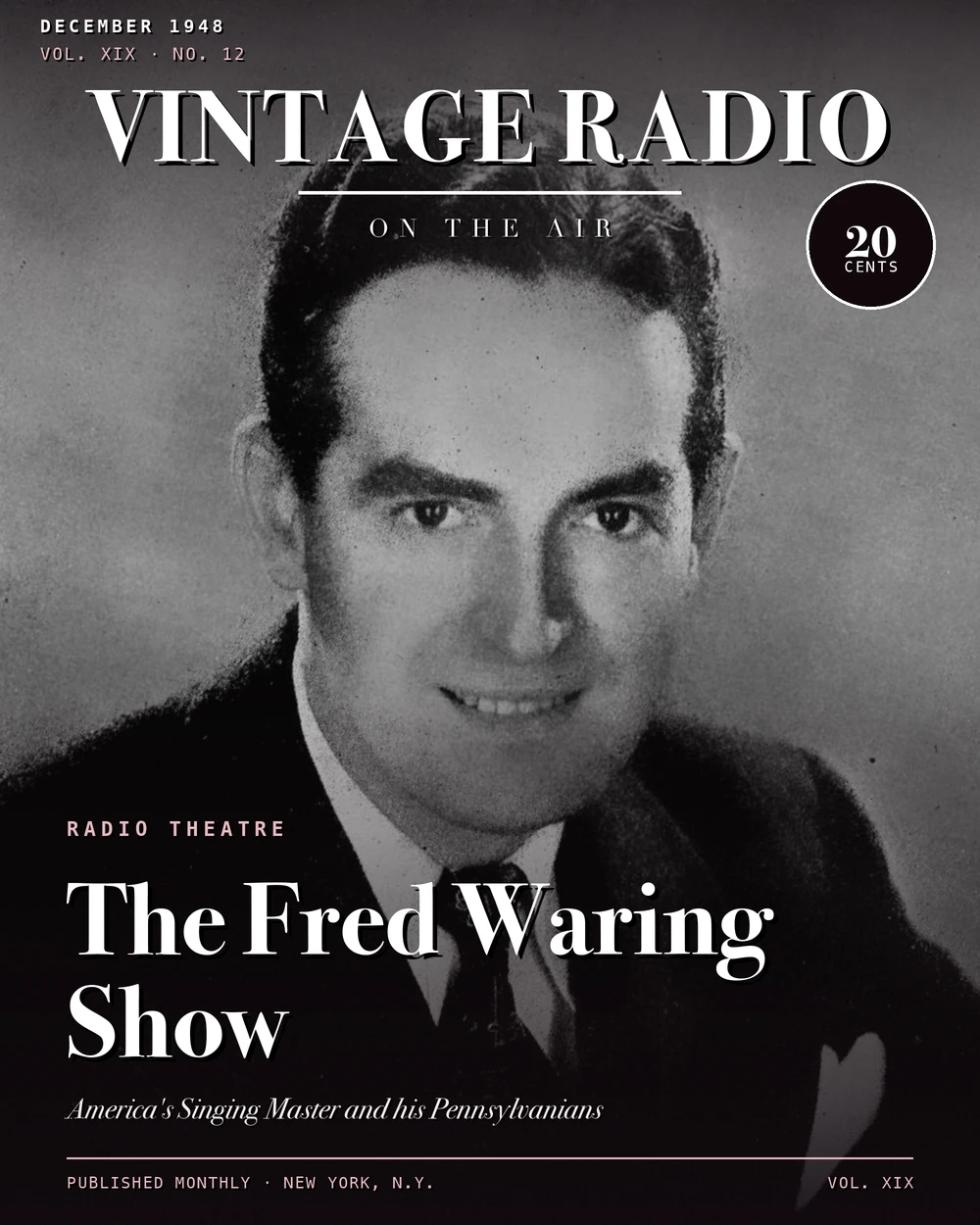
Fred Waring Show
How a Rejected Glee Club Audition Shaped American Radio
Fred Waring never made it into the Penn State Glee Club. He auditioned and was turned down every time. The irony is that he went on to build what may have been the most elaborate choral ensemble in radio history, fronting a group sometimes billed as "more than half a hundred Pennsylvanians" and spending a reported eight hours a day in rehearsal to make their harmonies sound effortless. Contemporaries eventually dubbed him "America's Singing Master" and "The Man Who Taught America How to Sing." The Washington Post wrote at Waring's death in 1984 that from 1940 to 1945 his 15-minute program five days a week was "the most popular show on radio." For a man who couldn't get into a college singing group, that's quite a career arc.
Waring was born on June 9, 1900, in Tyrone, Pennsylvania, and started his first band in 1917 with his brother Tom, Freddy Buck, and drummer Poley McClintock. At Penn State the group played local dates, calling themselves the Waring-McClintock Snap Orchestra, then Fred Waring's Banjo Orchestra, before landing on the name Waring's Pennsylvanians in 1922. That same year the ten-piece group played the University of Michigan "J-Hop" in Ann Arbor — none of them could read music, and Waring had never held a baton before. The J-Hop went well enough that promoter Fred Holliday booked them into the Kunsky Theatres in Detroit, and the band didn't go home for six months. Their first radio appearance followed almost immediately, on WWJ in Detroit, and it led directly to their first theater engagements.
Peter T. Kiefer, writing for an RCA historical release, described the Waring act as "fast-paced, curtain-to-curtain nonstop with no talk and no encores," and wrote that this approach "left the audiences breathless and applauding." The band hit the record charts in the mid-1920s with Sleep and Collegiate. That 1925 recording of "Collegiate" was the Victor Talking Machine Company's first commercial electric recording, and it became something of a flapper anthem. From 1923 until late 1932, the Pennsylvanians were among Victor Records' bestselling bands, recording more than 200 titles for the label.
The Choral Turn and the Making of the Radio Show
The shift from a hot instrumental band toward vocal harmony came, improbably, at the Roxy Theater in New York around 1930. Waring accepted a Roxy booking that required 50 instruments — far more than his then-20-piece group — and was held over for six months. The Hall Johnson Choir happened to be on the same program, and when Hall Johnson fell ill on opening night, Waring stepped in to lead the choir. The experience pointed him in a new direction. He wanted a glee club for his own band.
By some accounts, Waring turned down about two dozen radio offers because producers were uninterested in his choral concept. His first major radio show, on CBS for Old Gold starting February 8, 1933, gave him some room to develop vocal arrangements, but the sponsor grew dissatisfied and the run lasted only one season. The Ford Motor Company broadcasts that followed, starting in February 1934 on CBS and simultaneously on the Blue Network, were more accommodating. Those shows featured long musical passages blending well-known melodies into a general theme, alongside jazz arrangements and college songs. Ford was paying Waring $13,500 per performance — a figure established in the court record of Waring v. WDAS Broadcasting Station — which gave the production real resources.
The choral side of the show reached a new level through Waring's Hollywood work. The 1937 Warner Bros. picture Varsity Show was directed by William Keighley, with the finale directed and choreographed by Busby Berkeley; it starred Dick Powell and Ted Healy alongside Waring's Pennsylvanians and the Lane sisters, Priscilla and Rosemary. Roy Atwell, the show's stuttering comic, turned up in the film as Professor Washburn. The production was shot almost entirely on the campus of Pomona College, which stood in for the fictional "Winfield College." The original release ran 120 minutes; in December 1942 Warner Bros. re-released a cut version of 80 minutes, and evidence indicates the cuts were made to the original negative, leaving only the shorter version in the studio's archive. It wasn't Waring's first time on screen — he and the Pennsylvanians had appeared in the 1929 Syncopation, described as one of the first all-musical talking pictures, and in the 1930 Broadway production The New Yorkers.
What mattered most for the radio show, though, came off-camera at Pomona. Waring discovered the college glee club's conductor was ill, and the replacement stepping in was a student conductor named Robert Shaw. Waring invited him to New York to train the Pennsylvanians' glee club. Shaw placed an ad in the New York Times, received 600 to 700 applicants, spent two weeks auditing voices to select 100, then spent four more weeks narrowing that group to 24 singers. Shaw served as choral leader and coach; Waring was, by all accounts, the taskmaster.
The Sound and the Work Behind It
By 1939, when the Chesterfield association began, Waring fronted an 81-piece orchestra and glee club. The size of that ensemble made the show one of the most expensive productions on the air. When NBC moved Waring into daytime programming on June 4, 1945 — as part of an experiment to bring nighttime production quality to daytime radio — orchestra costs alone ran $18,000 a week, believed to be the highest for any daytime show at the time.
Signature music ran through the whole long run. Sleep, composed by Earl Burtnett and Adam Geibel and arranged by Tom Waring on the 1928 recording, served as the closing theme from the early 1920s onward. By 1939 the opening theme was I Hear Music. Another well-remembered theme during the Chesterfield years was A Cigarette, Sweet Music, and You, which wove the sponsor's name directly into the melody — a familiar device of the era that here got the full Waring choral treatment.
The music was described as appealing to listeners in a way similar to Guy Lombardo's — familiar melodies in distinctive arrangements — but it was the glee club that gave the show its particular character. Singer Charlie Ryan said Waring "got a real soft, beautiful sound from that glee club, just like a campus group sitting around singing pretty harmonies." Ryan also said Waring "had one of the best-staged shows I've ever seen, with the dancing dominoes and things like that." The Broadcasting trade publication described the programs as featuring "friendly banter with his crew, plus renditions of old-time favorite songs and ballads by the chorus and vocalists," and many broadcasts were built around a central theme — love, patriotism, anniversary salutes to notable figures — rather than simply running through a set list.
The preparation behind that sound was relentless. Performers spoke of rehearsals running eight hours a day. Waring regularly prepared twice as much material as he needed, then chose the numbers that still felt fresh after all that drilling. He would rehearse a single tune three different ways: in straight time, as a waltz, and in jive. Radio Life reported that he didn't tell his performers which rehearsed numbers would actually air that night, theoretically keeping everyone alert. He was described as genial and affable away from the bandstand and a tireless perfectionist at work. Those two qualities weren't in contradiction — they were the whole point.
A Deep Cast and Rotating Roster
The show carried a large and rotating ensemble of performers across its many years and sponsorships. The Lane sisters were soloists; Rosemary was often paired in romantic duets with Waring's brother Tom. Priscilla had come up through the Pennsylvanians and made her first Hollywood film, Varsity Show, after Warner Bros. signed her in 1937. Kay Thompson held a regular spot during the Ford Dealers years from 1934 to 1935, having come from the Bing Crosby–Woodbury Show; she later co-founded The Lucky Strike Hit Parade on CBS and eventually wrote the Eloise children's books.
The vocal groups shifted over the years. Stella and the Fellas — Stella Friend, Paul Gibbons, Roy Ringwald, and Craig Leitch — was one. The Three Girl Friends (Stella Friend, June Taylor, and Ida Pierce), Honey and the Bees (Diane Courtney, Hal Kanner, and Murray Kane), and Babs and Her Brothers (Blanche Redwine with brothers Charlie and Little Ryan, also known as the Smoothies) all appeared at various points. Comedic performers had a place too: Roy Atwell with his stuttering routine, Poley McClintock as a comic singer, and Lumpy Brannum, who played bass and violin alongside his comedy. Johnny "Scat" Davis handled comedy and trumpet. The piano duo of Livingston Gearhart and Virginia Morley — Virginia later becoming Virginia Waring after she married Fred in 1954 — added another dimension to the show's musical variety.
Announcers across the run included David Ross, Bob Considine, Paul Douglas during the Chesterfield period, and Bill Bivens in the 1940s. Tom Bennett was among the producers. Pembroke Davenport served as Waring's pianist and arranger, and Roy Ringwald was noted in contemporary reviews as one of "the top choral arrangers in the country."
Sponsors, Networks, and the Legal Fight Over Recordings
The show moved across networks and sponsors with notable frequency. Old Gold on CBS in 1933. Ford Motor Company on CBS and the Blue Network from 1934 to 1936. Bromo Quinine on NBC in 1938–39. Then Chesterfield cigarettes on NBC from June 1939 to June 1944 — the longest single sponsorship — during which the show was sometimes titled Chesterfield Time or Pleasure Time, broadcast as two 15-minute programs each day, Monday through Friday, one for the East Coast and one for other regions. During those Chesterfield years Waring also organized what was billed as the largest college glee club contest ever held in America, reflecting the show's particular following among young listeners. The Blue Network carried the show through the end of 1944 and into 1945. Various daytime NBC runs followed, sponsored by the American Meat Company, Florida Citrus Growers, Johnson's Wax, and General Electric. The Minnesota Canning Company picked up sponsorship for a Saturday morning run on NBC from mid-1949 to mid-1950. The final radio runs were on ABC in 1956 and 1957.
Throughout the 1940s and 1950s the program was created, rehearsed, and broadcast from the stage of Worthington Hall at the Shawnee Inn in Shawnee-on-Delaware, Pennsylvania — a unique arrangement that turned a resort hotel into a working radio studio. During World War II, 35 Pennsylvanians and production staff members entered military service, and under Tom Waring's supervision the Shawnee Inn rehearsal halls became an informal canteen feeding hundreds of servicemen weekly.
Behind all this network activity, Waring was also fighting a significant legal battle over who controlled his recordings. In 1935, Ford used transcriptions from his CBS broadcasts to produce promotional recordings distributed to some 300 radio stations through local Ford dealers — without Waring's authorization. The resulting litigation, Waring v. WDAS Broadcasting Station, Inc., decided by a Pennsylvania state court in 1937, established that a radio station could not broadcast Waring's phonograph recordings without his permission, recognizing a common-law property right in a performer's interpretation. A related 1939 federal case in North Carolina produced an injunction against a Wilmington station whose owner had aired a Waring transcription without authorization. To push back on unauthorized airplay more broadly, Waring had already founded the National Association of Performing Artists in 1935 with Bing Crosby's support; the board included Paul Whiteman, George Gershwin, Guy Lombardo, and Ray Noble. He had also stopped recording entirely in late 1932, reportedly because he believed phonograph records competed against his radio show, and the group didn't record again until 1942.
Beyond Radio and the Choral Legacy
Waring's investment in choral music extended well beyond the broadcasts. In 1947, he founded the Fred Waring Choral Workshop at Castle Inn in Delaware Water Gap, Pennsylvania, and taught those workshops for 37 years. One technique he stressed was pronouncing "every sound of every syllable of every word," so that lyrics were as clear to audiences as the music itself. That same year he relocated his music publishing company — originally called Words and Music, Inc., founded in 1943 — to Shawnee-on-Delaware and renamed it Shawnee Press; it eventually became one of the larger publishers of choral and instrumental music in the country.
Robert Shaw, who had trained the Pennsylvanians' glee club and went on to found the Collegiate Chorale in 1941 and the Robert Shaw Chorale in 1948, wrote the foreword to Virginia Waring's 1997 biography Fred Waring and the Pennsylvanians (University of Chicago Press). In it he stated: "It is certain to me that tours of the Bach B Minor Mass and the Mozart Requiem would not have been possible had not Fred Waring stimulated and helped to create an audience for choral music."
Waring's television work began on April 17, 1949, when the Fred Waring Television Show debuted on CBS as the first weekly one-hour musical show on television, airing on Sunday nights at 9 p.m. after The Ed Sullivan Show, with General Electric as sponsor. A Billboard review of the 1951 premiere episode called it "the model TV music show," praising its "smooth-running show with sparkle, change of pace and imagination." In 1964, Waring recorded two albums with Frank Sinatra and Bing Crosby for Sinatra's Reprise label: America, I Hear You Singing and 12 Songs of Christmas. In the 1960s and 1970s he introduced the Young Pennsylvanians, a group of younger performers who sang contemporary choral arrangements, which allowed him to continue touring roughly 40,000 miles a year by bus. President Ronald Reagan presented Waring with the Congressional Gold Medal on December 15, 1983 — only the fifth entertainer at that point to have received it in the medal's 100-year history. Waring suffered a stroke in 1980 and died on July 29, 1984, in State College, Pennsylvania, just after completing his annual summer workshop at Penn State.
Before his death, Waring designated the Fred Waring Collection at Penn State University Libraries — formally titled "Fred Waring's America: A Collection of Memories" — to house his archives. It contains memorabilia, his music library, recordings, scrapbooks, photographs, business correspondence, and more than 600 original cartoon artworks contributed by members of the National Cartoonists Society, whom Waring hosted at the Shawnee Inn annually for 25 years beginning in 1948; some 50 drawings were laminated onto 30-by-30-inch tabletops in what came to be called the Shawnee Inn's "Cartoon Room." The radio programs themselves survive in patches. At least 59 episode recordings are held in the Joe Hehn Memorial Collection, most of them from 1947 and 1948; Hehn was a pioneering OTR collector who began gathering recordings in the 1960s, and his materials were subsequently digitized. Researcher Martin Grams has documented more than 70 additional broadcasts surviving from before 1947, including one episode featuring Kay Thompson and several 1935 broadcasts with Priscilla Lane — enough to give later listeners a real sense of what Waring built, week after week, for nearly a quarter-century on the air.